
The Globe and Mail sparked a debate when it reported that Canada’s GDP per capita has fallen behind Alabama’s. The comparison rattled Canadians and triggered a wave of criticism about the validity of using GDP per capita as a measure of national prosperity.
Critics argue that GDP is a flawed metric, pointing to legitimate measurement challenges. But these measurement issues affect every country. The question is not whether GDP per capita is perfect but whether Canada’s trend relative to our peers signals deeper problems.
The evidence suggests it does.
The measurement debate misses the point
GDP per capita has well-documented limitations. It measures market output, not welfare, and excludes household production. Non-market activities go uncounted, digital goods are hard to capture, and a growing share of economic value comes from unpriced services that never show up in the statistics. It measures averages rather than medians, which can mask gains or losses for typical households. Median income better reflects the middle of the distribution but has its own limitations and can be distorted by government transfers, particularly COVID-19 supports. Deflating nominal GDP into real terms requires price indices that may understate quality improvements or fail to capture digital goods adequately.
GDP per capita also ignores income distribution, environmental quality, and other well-being metrics. It does not directly measure happiness, health outcomes, or leisure time. These are all legitimate concerns.
But here is what makes Canada’s situation different: We are not just dealing with measurement noise. We are seeing a systematic decline relative to countries dealing with the exact same measurement challenges.
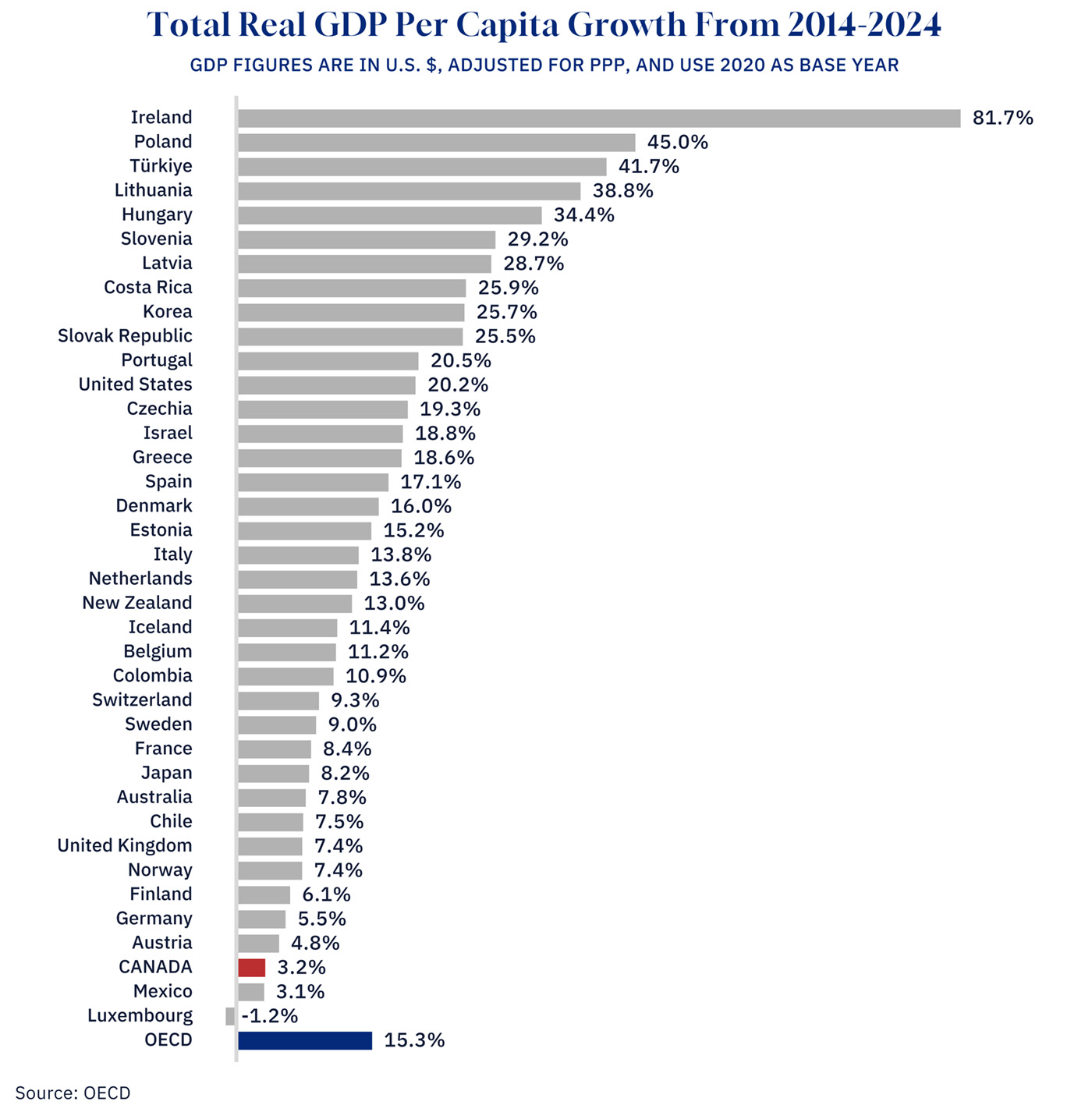
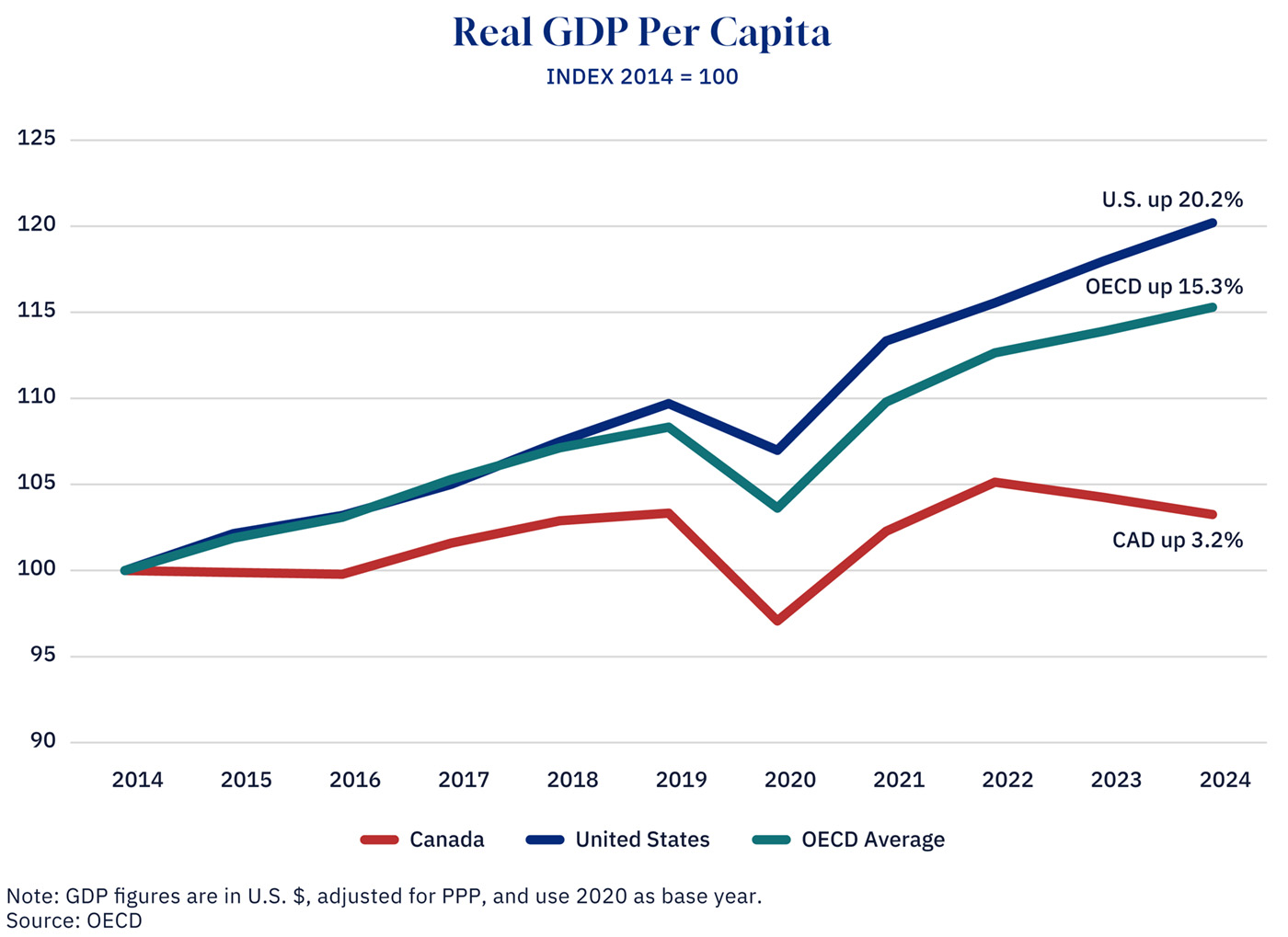
From 2014 to 2024, Canada’s real GDP per capita adjusted for purchasing power parity grew by just 3.2 percent in total, an anemic 0.4 percent per year on average, and the third lowest among 38 advanced nations. Over the same period, the United States posted 20.2 percent total growth (1.9 percent annually), and the OECD average reached 15.3 percent (1.4 percent annually). The measurement shortcomings cannot explain five-to six-fold differences in growth rates.
Graphic Credit: Janice Nelson.
Graphic Credit: Janice Nelson.
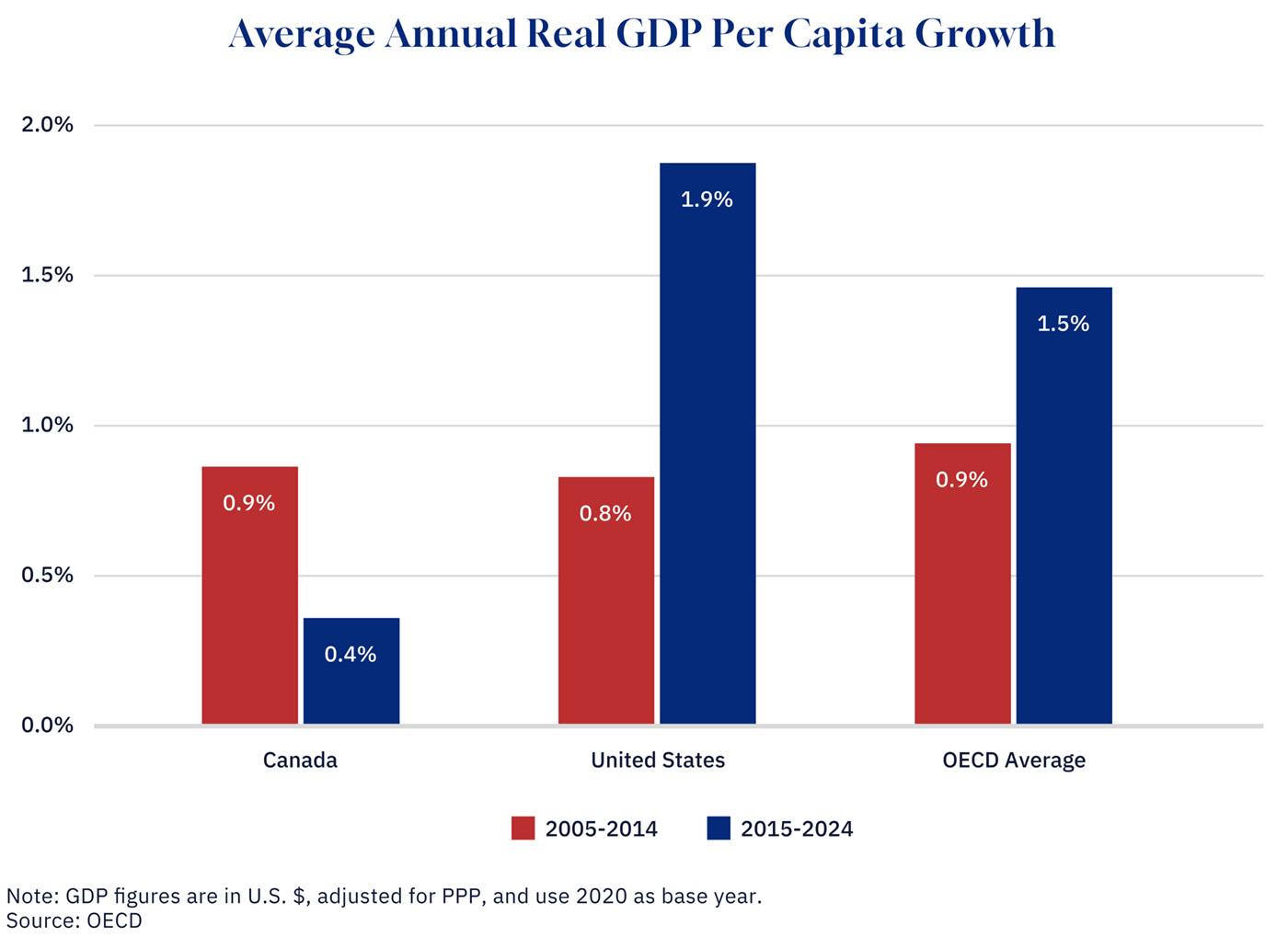
Yes, this period coincides with the pandemic and an oil price shock. But for perspective, in the previous decade, which also encountered the global financial crisis, Canada’s real GDP per capita grew at 0.9 percent annually, roughly on par with the United States (0.8 percent) and the OECD average (0.9 percent). The divergence is recent and dramatic.
Graphic Credit: Janice Nelson.
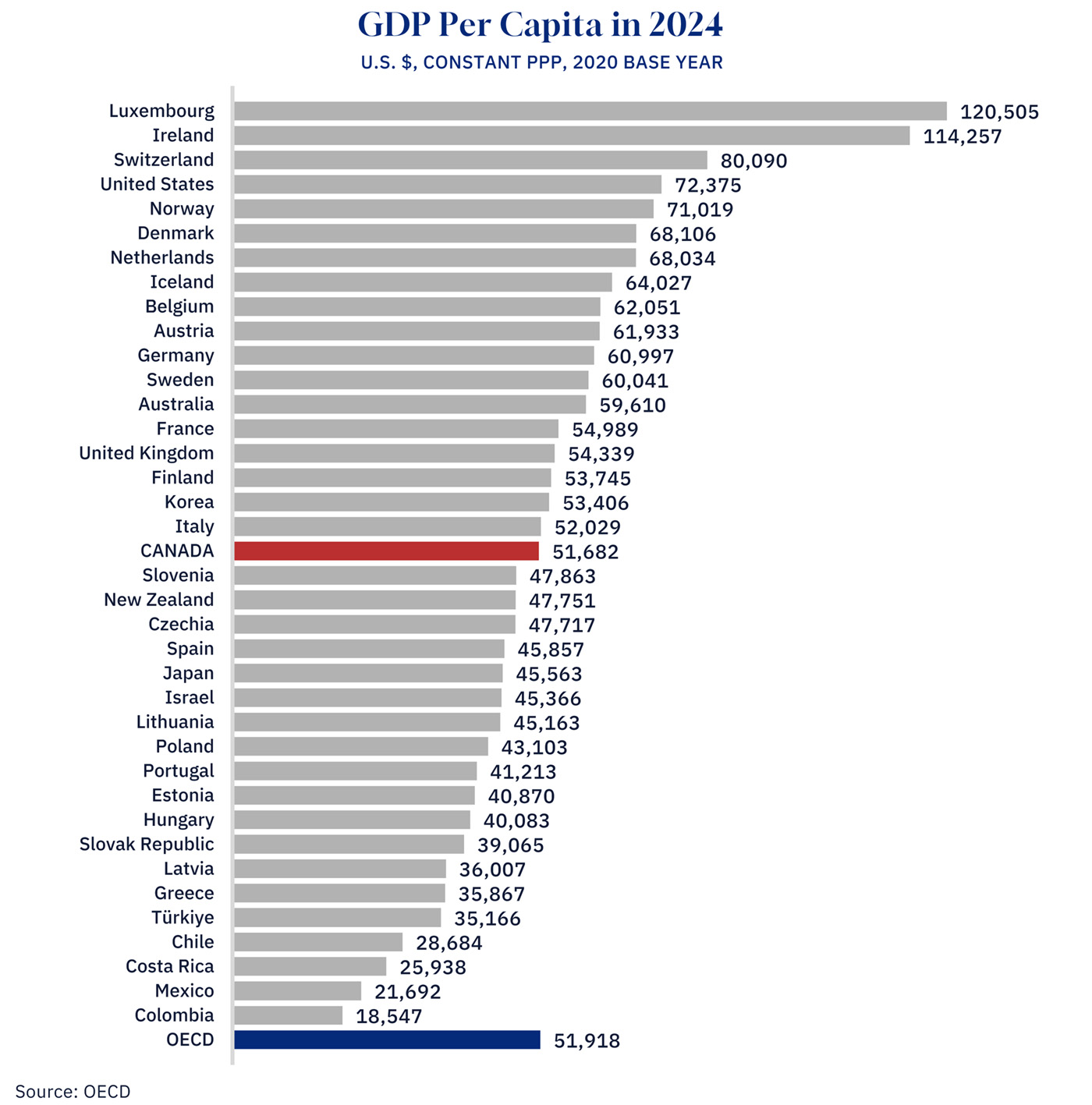
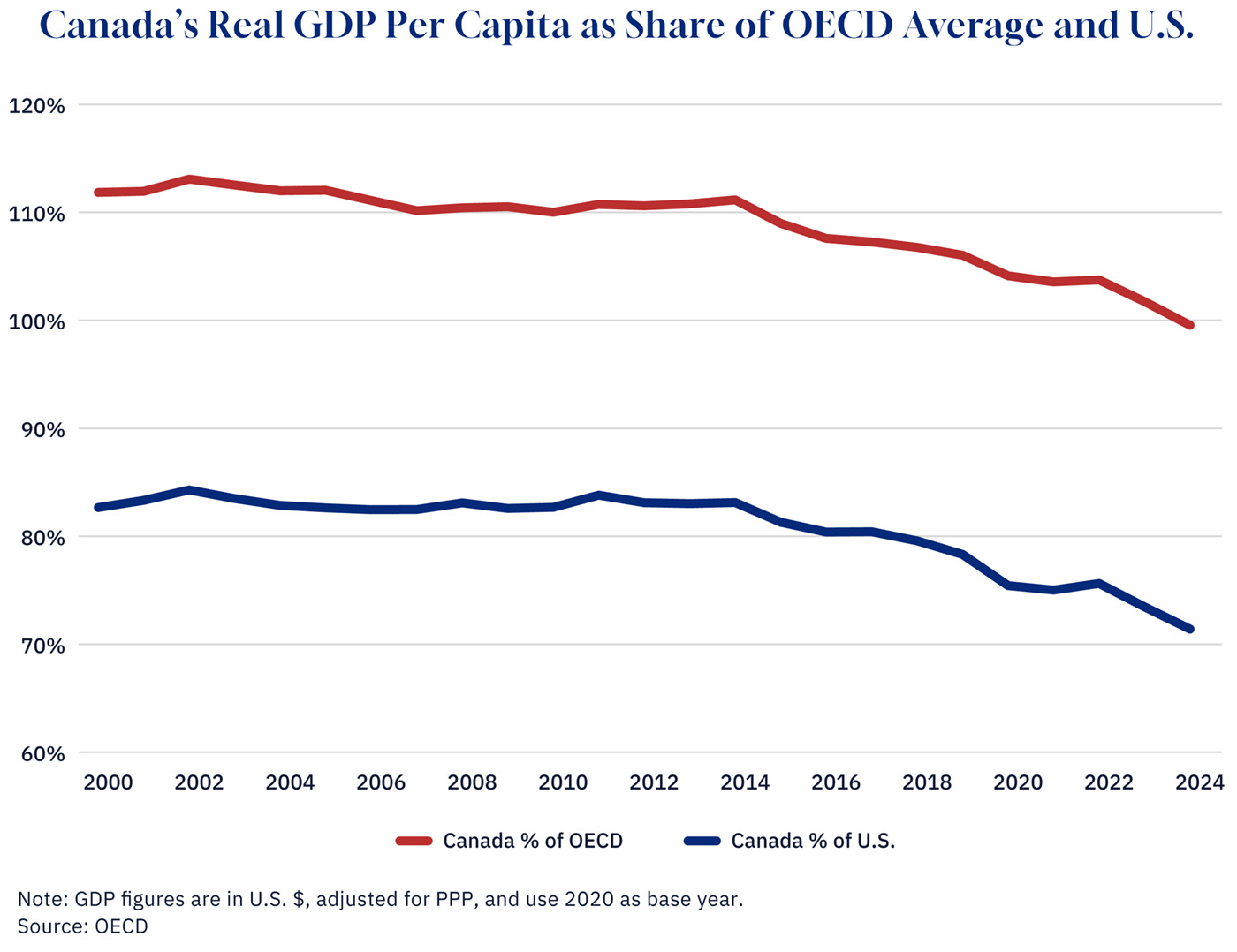
Canada’s real GDP per capita now ranks 19th among 38 OECD countries, down two positions from 17th in 2014. More troubling is the deterioration in Canada’s relative position on two fronts. Against the United States, Canada fell from 83.1 percent of American GDP per capita in 2014 to just 71.4 percent in 2024. Against the OECD average, Canada historically exceeded it but dropped to 99.5 percent in 2024, falling below average for the first time in recorded history.
The trend is what matters. This is not a measurement quirk; it’s a systematic decline.
Graphic Credit: Janice Nelson.
Graphic Credit: Janice Nelson.
GDP correlates with what we actually care about
If GDP per capita were disconnected from other measures of well-being, its stagnation might not matter. But the empirical evidence suggests otherwise. GDP per capita tends to correlate with the very social indicators that critics say we should care about instead.
In his recent Hub analysis, Mike Moffatt shows how Canada’s weak GDP per capita mirrors declining relative performance across multiple dimensions of social well-being. Our global ranking on the United Nations’ Human Development Index dropped from 13th in 2013 to 16th in 2023. The World Happiness Report shows Canada falling from 5th in 2012 to 18th in 2025.
According to the 2026 World Happiness Report, released after Moffatt’s analysis, Canada’s standing has dropped further to 25th. The generational divide is particularly troubling: young Canadians under age 25 rank 71st globally in happiness vs 24th for the rest of the population. Lack of housing affordability likely plays a role in the comparative unhappiness among the younger cohort.
The international evidence supports these patterns. Cross-country analysis of up to 146 countries reveals that higher GDP per capita strongly correlates with better well-being outcomes: higher life expectancy (correlation of 0.71), lower infant mortality (-0.65), and lower inequality (-0.55). Recent data from 2024 covering over 150 countries shows a clear positive relationship between GDP per capita and self-reported life satisfaction, with no evidence of a satiation point where additional income stops mattering for well-being. Research by Sacks, Stevenson, and Wolfers finds that even in wealthy nations, higher GDP per capita continues to correlate with higher reported well-being, challenging earlier claims that economic growth becomes irrelevant above certain income thresholds.
View reader comments (5)
This does not mean GDP per capita captures everything. Economist Dan Ciuriak has noted that Canada’s higher life expectancy relative to the United States provides an implicit benefit not reflected in GDP comparisons. Using value-of-statistical-life methodologies, Ciuriak estimates this longevity advantage represents a substantial “good governance premium” that, if included, would materially narrow the apparent Canada-U.S. income gap.
These quality-of-life dimensions matter. Yet even accounting for such factors, the broader pattern is concerning. When economic output per person stagnates, governments have fewer revenue-based resources to fund health care, infrastructure, and other social programs.
A false choice between growth and equality
Some critics acknowledge Canada’s relative GDP per capita decline but argue it reflects a defensible trade-off: we accept lower income in exchange for greater equality. The data contradicts this narrative.
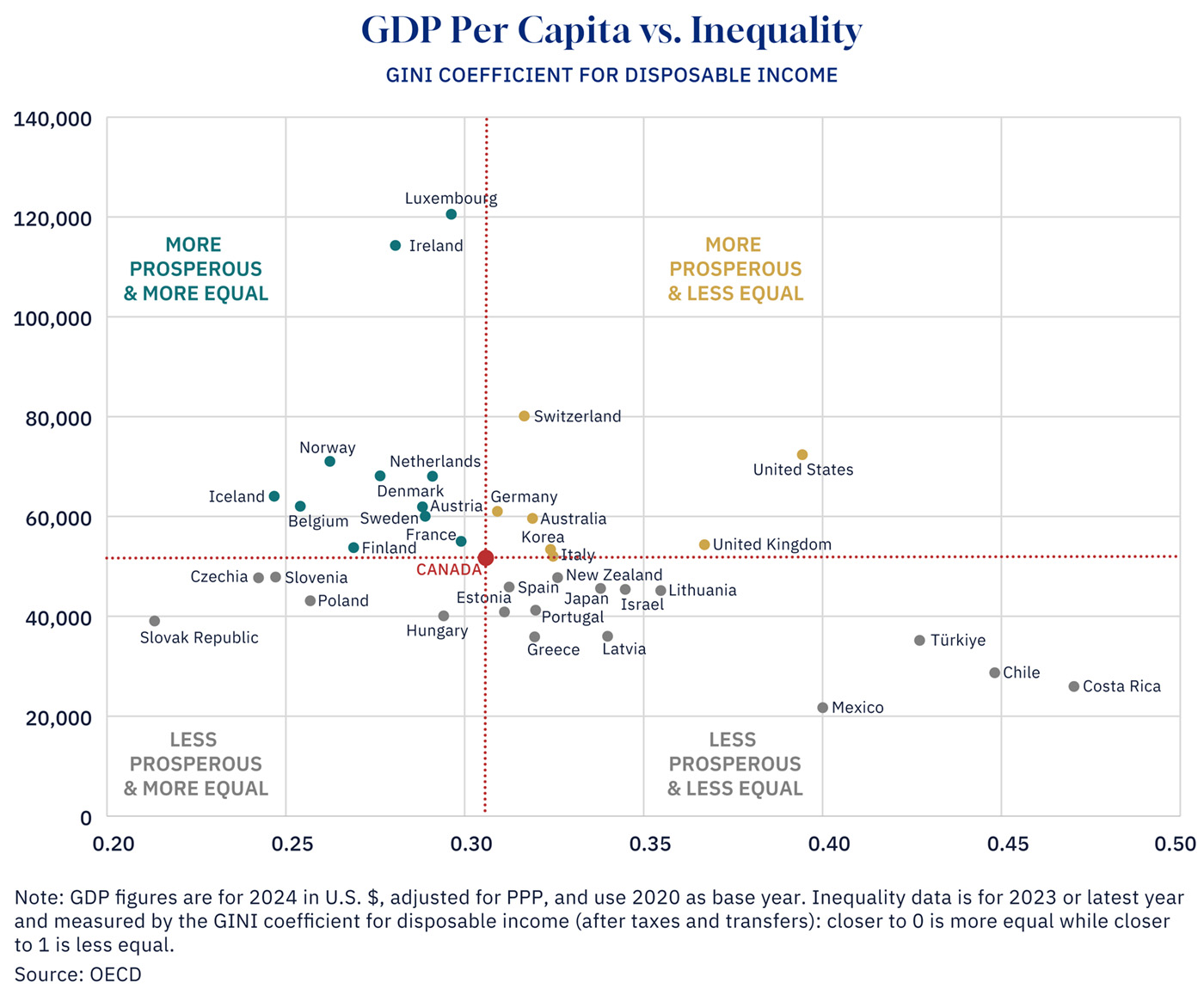
Eleven OECD countries achieve both higher GDP per capita and greater income equality than Canada, after accounting for the welfare state’s tax and transfer system. For reference, Canada’s GDP per capita stands at approximately $52,000. The list of countries that are more prosperous and more equal spans from Luxembourg ($121,000) and Ireland ($114,000) to Scandinavian nations of Norway ($71,000), Denmark ($68,000), and Sweden ($60,000). The Netherlands, Belgium, Austria, Iceland, France, and Finland complete the roster of countries demonstrating that higher prosperity and equality can coexist.
Several additional countries achieve higher prosperity with similar equality: Germany ($61,000) maintains virtually identical income distribution to Canada, while Switzerland ($80,000) and Australia ($60,000) achieve significantly higher GDP per capita with only marginally less equal outcomes.
The United States represents a starker trade-off: 40 percent higher GDP per capita than Canada but substantially greater inequality (Gini coefficient of 0.394 versus Canada’s 0.306). The United Kingdom falls between these extremes with modestly higher income but markedly greater inequality than Canada.
Graphic Credit: Janice Nelson.
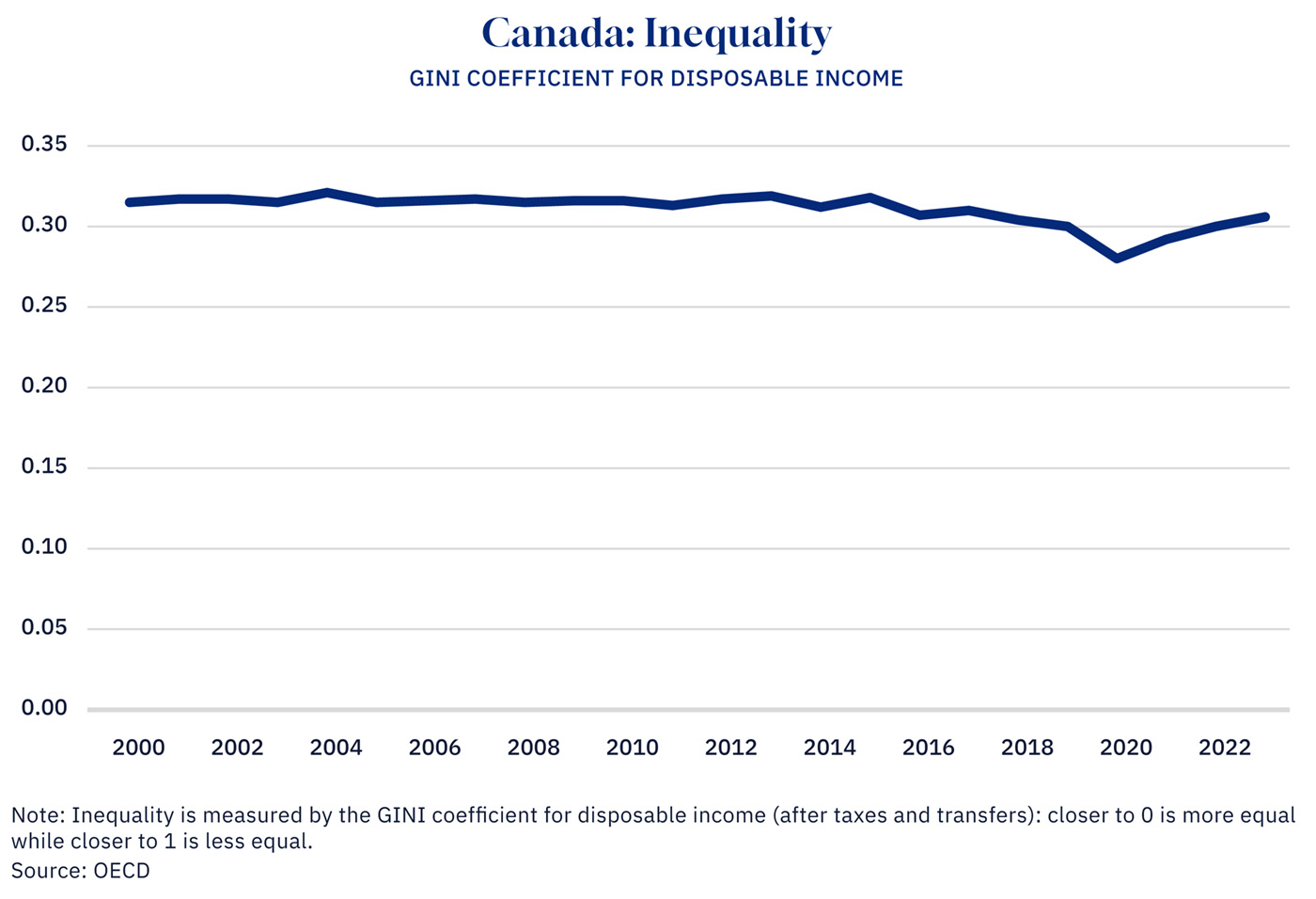
Canada is not choosing equality over growth. We have fallen to 99.5 percent of the OECD average GDP per capita in 2024, down from above average historically, while maintaining only middling equality. Apart from modest pandemic-era improvements, our income distribution has remained essentially unchanged. We are falling behind in prosperity without material gains in equality.
Graphic Credit: Janice Nelson.
On the income gap with the U.S., a recent Bank of Canada study has important insights about income concentration. Three-quarters of the Canada-U.S. GDP per capita gap lies among the top 10 percent of market income earners. The bottom half of Canadians earn roughly 95 percent of what their American counterparts earn. But the gap widens dramatically moving up the distribution, with the top 1 percent of Canadians earning only 40 percent of comparable American incomes.
This concentration points to the selective emigration of high-ability workers. The analysis estimates that a substantial share of Canadians who would rank among top earners in Canada have emigrated to the United States—roughly 40 percent of potential top 1 percent earners and 30 to 50 percent of the next nine percentiles. Canadian-born individuals in the United States are more educated than native-born Americans, earn substantially more, and cluster disproportionately in top income deciles.
Canada is effectively exporting its inequality to the U.S. The brain drain simultaneously lowers our average income while raising American income, accounting for a significant share of the persistent GDP gap.
Bottom line: the international evidence shows prosperity and equality aren’t necessarily substitutes. The policy challenge is pursuing reforms that drive productivity growth, retain high-ability workers, and maintain or enhance social mobility.
The immigration red herring
Some defenders of Canada’s economic performance point to immigration as explaining weak per capita GDP. After all, rapid population growth increased the denominator in the per capita calculation, mechanically reducing the ratio even as total GDP grew.
This argument misses the policy choice embedded in that growth. Immigration is not an exogenous shock but a policy lever. Canada’s annual population growth averaged around 1.0 percent from 2004 to 2014, but climbed to 1.5 percent from 2015 to 2025, including surges of 3 percent each year in 2023 and 2024.
Temporary residents surged from less than 1 million in 2014 to around 3 million by early 2025. Permanent immigration also increased, rising from approximately 260,000 annually in the early 2010s to nearly 500,000 each year from 2021 to 2024. These were deliberate policy decisions about admission levels.
The immigration surge exacerbated the productivity challenge on two fronts. First, the composition shifted toward temporary, lower-skilled workers crowding out some of the high-skilled immigrants who complement capital investment and drive innovation. Second, the sheer volume increased population growth, making labour abundant, and encouraging the substitution away from capital. When businesses can easily access abundant low-skilled labour, they have less incentive to invest in the capital equipment and technology that boost output per worker. Together, both forces undermined productivity and the growth of real GDP per capita.
To be clear, the policy choices about immigration levels and composition are part of a broader set of challenges affecting productivity, not a separate phenomenon that fully explains Canada’s underperformance.

The fiscal mirage
Even Canada’s headline GDP per capita figure, while weak, may overstate our underlying economic health. Total government spending as a share of GDP increased from approximately 38 percent in 2014 to 45 percent in 2024. Much of this incremental spending was deficit-financed. GDP accounting treats government spending as contributing to output regardless of whether it is funded through current taxation or future obligations. Putting aside the potential displacement of private sector activity, this creates a “fiscal mirage”—headline GDP growth that does not reflect sustainable economic activity.
So, within Canada’s already weak GDP per capita performance, a growing share comes from government. As government’s share of the economy expands through deficit spending, it can temporarily prop up headline GDP figures even as the private sector struggles. This matters because the productivity growth that drives economic progress comes primarily from the private sector. Accumulated debt eventually requires servicing through higher taxes or reduced services, both of which drag on future growth.
Proponents of a larger government role might argue that this expansion is positive. Higher public spending improves quality of life, reduces inequality, and provides essential services. This perspective deserves consideration.
The relationship between rising government spending and social outcomes is complex. Empirical research by economist Livio Di Matteo suggests Canada has surpassed its growth-maximizing point. Economic growth is generally optimized when total government spending remains between 24 and 32 percent of GDP.
Consider specific measures during Canada’s period of government expansion. Measured poverty declined through 2020 as the federal government increased the child-related cash transfers. Inequality modestly declined during the pandemic according to the adjusted after-tax income Gini coefficient, though it increased on other inequality indicators. Yet both metrics have since worsened from the pandemic low, even as government spending continued to expand as a share of GDP.
Food bank usage has doubled since 2019, with over 2.2 million visits in March 2025 alone. Violent crime severity is significantly up over the past decade. Health-care wait times reached 28.6 weeks in 2025, the second-longest ever recorded. Canadian students’ scores on standardized tests (PISA) have declined steadily, though Canada still ranks among top-performing countries globally.
At the same time, government productivity has been declining while the share of the workforce employed by government continues to expand to record levels. We are getting a larger government sector without corresponding improvements in efficiency or social outcomes that might justify the expansion.

What drives prosperity in the long run
The fixation on GDP per capita obscures a more fundamental question: What actually drives rising living standards over the long term? The answer is productivity growth, which depends on capital deepening and innovation.
Workers equipped with better tools, technology, and knowledge produce more valuable output per hour worked. This enables higher wages without inflation, supports public services, and allows for sustainably rising living standards without borrowing from the future.
Canada’s performance on these key drivers gives cause for concern.
Granted, the collapse in oil prices after 2014 delivered a significant external shock to Canada’s resource sector. This affected investment levels, particularly in Alberta and Saskatchewan, and contributed to the overall investment decline. External factors matter and deserve acknowledgment.
But the investment crisis extends well beyond the resource sector and has persisted even as oil prices recovered.
Business investment per worker has been declining for a decade. Our stock of machinery and equipment is falling. Canadian businesses today operate with less physical capital per worker than they had 10 years ago. Canada invests less than peer countries across important knowledge-economy measures, including intellectual property. Business expenditure on R&D as a share of GDP has flatlined recently and sits at just 1.1 percent, well below the OECD average of 2.0 percent. Venture capital investment, the lifeblood of entrepreneurial startups, is falling as a share of GDP. The shifting composition of venture capital has created an environment where Canadian entrepreneurs often must scale their companies south of the border.
Putting aside GDP measurement issues, these trends in capital and innovation are hard to ignore. The GDP per capita decline is the symptom. The investment crisis is the disease.

Policy choices determine outcomes
The problem is less about the metric and more about the policies that have contributed to a decade of underperformance. Our tax system creates disincentives for investment and talent. Our regulatory burden imposes significant costs on businesses and deters development and entrepreneurship. Protected sectors shelter incumbents from competition.
The Alabama comparison stung because it crystallized a decade of underperformance that many were reluctant to acknowledge. Canada has been falling behind, and the metrics capture an uncomfortable story about policy choices. We can continue debating whether GDP per capita is the perfect measure, or we can focus on the reforms that would improve performance across every measure that matters.
The measurement debate has its place. But the policy imperative deserves more attention.
DeepDives is a bi-weekly essay series exploring key issues related to the economy. The goal is to provide Hub readers with original analysis of the economic trends and ideas that are shaping this high-stakes moment for Canadian productivity, prosperity, and economic well-being. It features the writing of leading academics, area experts, and policy practitioners. The DeepDives series is made possible thanks to the ongoing support of the Centre for Civic Engagement.
Charles Lammam’s article addresses the debate surrounding Canada’s declining GDP per capita, particularly in comparison to the United States and other OECD countries. While acknowledging the limitations of GDP as a sole measure of prosperity, the author argues that Canada’s relative decline signals deeper economic problems. The article highlights that Canada’s GDP per capita growth has significantly lagged behind its peers, correlating with declines in other well-being indicators. It challenges the notion that Canada is trading growth for equality, pointing out that several countries achieve both higher GDP per capita and greater income equality. The author attributes the decline to factors like declining business investment, emigration of high-skilled workers, and the impact of immigration policies on productivity.
The article suggests Canada's GDP per capita decline is a symptom of what? What policy changes are needed to address the root cause?
How does Canada's immigration policy contribute to the GDP per capita issue, according to the article? Is it solely to blame for the decline?
The article mentions a 'fiscal mirage.' What does this mean in the context of Canada's GDP, and what are the potential long-term consequences?







Comments (5)
Something to add to this article – the reason nothing is being done about our malaise.
Boomers care about economic health as much as anyone else, but they’re predominantly asset owners, not wage earners.
With stock markets at record highs they’re not feeling any of what this article described and so they feel no urgency to fix anything.
Above all else, the policy that killed Trudeau was his capital gains tax increase. It’s the only time this past decade that the liberals went after Boomer money and they damn near lost party status. Carney reversing it was (in my opinion) far more important to his surge than cancelling the carbon tax.
All that to say, we won’t have any change in Canada until boomers feel economic pain again.